
Is Your Child Ready for Preschool?

Preschool

Image via Wikipedia


I speak with parents of preschoolers all the time. 

One of the questions that I hear very frequently is, “I want to send my child to preschool.  How do I know if he (or she) is ready?”

There are several key indicators we can look at that will help us answer that question.  You need to observe your child to see:

1.    How well does he interact with others?

If you feel your child has not had enough opportunities to interact with others then:

START SMALL: arrange play-dates with neighbor children of a similar age and attend library story programs.  The summer before our youngest son was going to start kindergarten, we enrolled him in a three week nature class that was held every morning at a local nature center.  He had not attended preschool or daycare and we wanted to give him a chance to be in a “classroom” setting.  This worked out very well and he adjusted to kindergarten very well.

2.     Has she been away from you?

If your child has not been away from you at all then

START SMALL: arrange to leave your child with a trusted friend or relative for an hour or so (take a walk around the block or a bubble bath) and enroll her in a library story hour or other local program where she will have other adults who are in charge.

3.     How well does he transition from snack to play to story to craft to quiet time?

If your child has not had any experience with this or does not transition well then

START SMALL: during the day, let your child know you will be turning off the TV at the next commercial…tell him it will be naptime after the last page of the book is finished…find opportunities to have your child transition from one activity to another.

4.     Can your child’s speech be understood?

Your child should be able to speak in simple sentences of three to five words and be able to describe an activity or event that recently happened.  If you think there is a problem, then speak with your pediatrician.  If there isn’t a problem, perhaps your child hasn’t had enough opportunity to verbalize.

START SMALL: Give your child opportunities to express himself…when reading a picture book, have your child tell you what is happening on the page and then let your child retell the story to you from the pictures…at the store, encourage your child to describe what he sees.  It is so important for us to listen to our children…they really have a lot to tell us.

5.     Does your child follow directions?

If your child does not seem able to follow directions then

START SMALL: give your preschooler easy tasks to do…put the plates on the dinner table, help fold the clean towels…when cleaning up the toys, ask your child to put the blue blocks away first or tell her to pick up the book and put it on the couch.

There are two other factors that may have an impact on whether your child is ready for preschool: potty training and age.

Many preschools require students to be potty-trained or almost there.  Your preschooler should also be able to put on and take off her shoes and coat, zip up her pants and wash her hands.  These are some of the early life-skills your child needs to learn…please be patient…it takes time and practice to grow up and master these tasks.

Regarding age, educators define preschool as the two years before kindergarten.  The age minimum differs in preschools…some want the child to be three by December of that academic year, while others will accept two year olds.

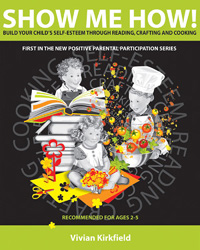
Whatever your decision is about sending your child to preschool, spending time with your child will result in life-long benefits…building self-esteem, developing pre-literacy skills and strengthening the parent-child bond.   If you visit my website and buy a copy of Show Me How! Build Your Child’s Self-Esteem Through Reading, Crafting and Cooking, you will be getting a unique activity book/parenting resource/memory book that will provide you with picture book summaries, easy crafts and healthful recipes…even an hour-by-hour schedule that will simplify your day.   Using Show Me How will definitely help you achieve your child’s school readiness goals.  We offer your money back if you are not satisfied with the contents and the results and the book is on sale now for 50% off the cover price…only $22.50 per copy.
Some MoreThoughts on Healthy Eating…for Summer-time and Beyond

Small child with head down on highchair.

Image via Wikipedia

As parents, we are responsible for what our children eat…at least when they are little.

We plan the meals, shop for the ingredients, prepare the food and serve it.

So every young child should be eating a healthy balanced diet, right?

Unfortunately, many young children are NOT eating a healthy balanced diet because:

  • Many parents didn’t have a healthy diet themselves as children and don’t really know what to serve!
  • The media overloads us with commercials about fast food and sugary desserts!
  • Young children can be fussy about eating and concerned parents just want them to eat SOMETHING!

Here are some simple steps parents can take to help:

1.     Plan regular meal-times…if children know they can get something to eat at any time of the day or night, they will not be motivated to eat breakfast, lunch and dinner.  And having family meals together provides so many other emotional and social benefits as well. 

2.     Snacks are important additions to a young child’s daily food intake… provide nutritious ones like veggie sticks dipped in hummus, cheese cubes with whole grain crackers and fruit slices in yogurt.

3.     Serve small portions…young children can be overwhelmed when a plate piled with food is put in front of them…for instance, if your child is having a sandwich, cut it in quarters and serve one quarter at a time.

4.     Use your imagination to make meals pleasing to the eye…attractive plates and servings arranged in an interesting way…for example, a small bowl of spaghetti with two meatballs for the eyes, a steamed baby carrot for the nose and several steamed green beans for the smile.  What fun!  You can always add a new “nose” and new “smile” when your child finishes the first ones.   Or how about using cookie cutters to make interesting shapes of sandwiches?

5.     Avoid processed foods as much as possible…they are usually filled with salt, sugar, preservatives and artificial colors and flavors.  When your children become accustomed to these, they can lose their appreciation for the flavor and goodness of wholesome natural foods.

There are many websites that can help with nutrition information and meal planning.

http://nutritiondata.self.com/

http://fnic.nal.usda.gov/nal_display/index.php?info_center=4&tax_level=1

http://www.mealsmatter.org/

http://www.healthy-eating-made-easy.com/healthy-meal-planning.html

For more meal-planning tips, fresh ideas and simple recipes that your children can help prepare, you can get a copy of Show Me How! Build Your Child’s Self-Esteem Through Reading, Crafting and Cooking…now on sale for 50% off the cover price on my website.  For only $22.50, you will have 100 child-friendly recipes, 100 arts and crafts activities and 100 picture book summaries that all build self-esteem, develop pre-literacy skills and create a life-long parent-child bond.  Did you know that this great resource is also a memory book…with lined spaces on every other page for you to record your child’s highlights?

Watch The Sweets This Summer: What Are The Alternatives?

An arrangement of confections

Image via Wikipedia

We are a nation that loves sweet things.

If you read the ingredient label of almost every boxed or packaged food (we’re all reading the labels, aren’t we?), you’ll find that sugar, or some sugar substitute, has been added.

Cereals, breads, macaroni and cheese, beverages, frozen dinners…the list is endless and I’m not even talking about “sweet” treats like cookies, candies and ice cream.

“Today, (beet and cane) sugar has become a devastating American habit; it is quite impossible to find a commercial or canned food of any kind that does not contain it.  In a lifetime, the average American eats three tons of sugar.  Sugar injures the heart, causes overweight, decays teeth and creates diabetes, yet once upon a time it had no place at all in the American diet.  When sweetening was confined to honey and maple syrup, the American was indeed a healthier being.”

This quote is from Eric Sloane’s Once Upon A Time: The Way America Was.  It was published in 1982 and the sugar situation has not gotten better…it has gotten worse and many of the artificial sugar substitutes turned out to be worse than the product they were replacing.

Parents have an obligation to “raise up their children as they would have them go on” in life.  The time to set the parameters of what is good to eat and what is not is when children are young. 

How can we help our children avoid too much sugar and develop good eating habits?

  • Read the ingredient labels and put back a product that has unnecessary sugar.
  • Know that “sugar” comes in many forms and is called by many different names: glucose, fructose, high fructose corn syrup, sucrose, maltose, crystalline fructose, polysaccharide, monosaccharide, galactose, dextrose, corn syrup…you get the picture.
  • Try making at least some of your menu items from “scratch” because then you will know exactly what you are putting into the food your family is eating. 
  • Get into the habit of offering water when children are thirsty…flavored beverages and soda are FULL of sugar…empty calories and no nutrition.  100% juice has lots of “natural” sugar as well…try using ½ juice with ½ water…you will have a healthier, cheaper and more thirst-quenching drink.  Pour this mixture into ice-pop molds and you will have inexpensive and refreshing pops.
  • Put a limit on the number of “sweet” treats…keep cut up carrot and cucumber sticks in the fridge.
  • Be a good role model…does your child see you having a donut with your coffee, spooning sugar on your morning cereal, eating a chocolate covered ice-cream pop after lunch and then sitting down with a piece of cake after dinner?

If you are looking for some simple healthful recipes that your child can help you prepare in the kitchen, Show Me How! Build Your Child’s Self-Esteem Through Reading, Crafting and Cooking provides 100 of them.  Head over to my website and buy a copy of this award-winning book at 50% off the cover price.  You won’t be wondering what to do with your little ones this summer because there are also 100 arts and crafts activities and summaries of the 100 picture books every young child should hear.