Building Self-Esteem: The Chocolate Rabbit


Today is Perfect Picture Book Friday where I link up with Susanna Leonard Hill’s fantastic group of writers who contribute a picture book review and related resources. 

I’m always looking for books with characters who are engaged in self-esteem building.  Not only is this the case with my selection today, but the book is also a perfect choice for the upcoming holiday of Easter.  I know that parents and teachers will enjoy the simple eco-friendly craft project at the end of my review.

Do you know where the first chocolate Easter bunnies were made?  Here is the scoop, according to picture book author and illustrator, Maria Claret.
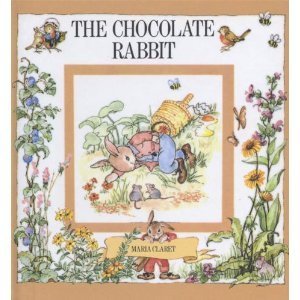


The Chocolate Rabbit

Written and illustrated by Maria Claret

Translated by Jane O’Sullivan

Publishers: Barons Juvenile (originally published in Spain)

Ages: 2 – 8

Themes: Mastering tasks and skills, Easter, crafting, dealing with disappointment, family togetherness

Opening: “Not so very long ago, the Rabbit family lived in a little town not far from here.”

Synopsis:  Bertie Rabbit and his sisters want to help their artistic father who paints beautiful Easter eggs, but they are too young.   Bertie decides he is old enough to help his father and buys eggs with his own money, intending to decorate them and surprise his father.  The little bunny is sadly disappointed when he trips and the basket tips over, breaking all of the eggs.  Bertie’s mother makes a pot of chocolate to lift her son’s spirits…but when Bertie climbs up for a taste, disaster strikes and Bertie is covered in lukewarm chocolate.  Bertie’s father looks at his son and has an ingenious idea…chocolate bunnies! 

Why do I like this book

Success often comes on the heels of failure!  I love books that encourage children to keep on trying as they learn to master tasks and skills.  Self-esteem is not built with empty praise…it is developed and strengthened as young children learn to do things for themselves.  A child’s sense of self-worth increases as he takes these important steps…and learning to deal with disappointment is one of those steps.  This is a sweet story about working together as a family…relevant with the busy hectic pace many families experience today…each family will find their own unique ways of spending quality time together.

The illustrations are charming…they remind me of Beatrix Potter’s work.

Related Activities:

Child Care Lounge has quite a few lovely Easter crafts as well as bunny poems here

Angel Fire has an Easter/Spring Unit with many book and craft and cooking ideas here.

Mama-Knows (colored egg picture below) has lots of recipes for coloring Easter eggs here.

Children love arts and crafts!  Here is an activity that will please every eco-minded parent.

PAINTING EASTER EGGS WITH NATURAL DYES
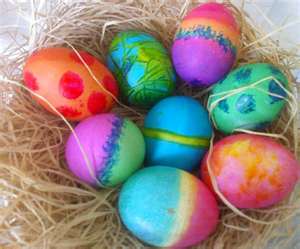
 

You will need: Hard-boiled white eggs (cooled), Q-tips, one or more of the following depending on how many colors you want: ¼ cup blueberries (blue), ¼ cup cranberries (red), 1 tsp tumeric (yellow), markers, a small bowl for each color, cover-ups, two small pots and water to boil.

1.      Cover the work surface and workers to protect from staining (wear disposable plastic gloves if desired).

2.      Boil ½ cup water, add crushed blueberries, simmer for 5 minutes and then pour into small bowl and let cool for a few minutes.  Do the same for the cranberries.

3.      Pour 1 tsp tumeric and ½ cup hot water in a small bowl, stir and let cool.

4.      Put an egg into each bowl and let sit for 5-10 minutes, turning several times with a spoon.  Then lift each egg out and let dry.

5.      Use markers to add designs.

6.      Tip: while waiting for the eggs to absorb the color, go on a color-naming hunt throughout your house…how many red, blue and yellow items can your child find? 


This post is part of a series for parents and teachers called Perfect Picture Book Fridays hosted by Susanna Leonard Hill.  Click on her link and find lots of other picture book suggestions with summaries and activities.

Perfect Picture Book Friday: One of the Problems of Everett Anderson

Today is Perfect Picture Book Friday where I link up with Susanna Leonard Hill’s fantastic group of writers who contribute a picture book review and related resources every Friday.

But first,I want to announce the February PPP Reading Challenge picture book winner.  It was lovely to see what some of you were reading to your children.  I know how difficult it is to find the time to post your comments.  And the winner is….AngelaMarie…she is a very talented poet and artist as well as a mom.  Please take a minute and visit her beautiful blog: One-In-Creation.

And now, on to my Perfect Picture Book Friday selection.

When I first read this story several years ago, I decided to use it as one of the hundred picture books that are recommended in Show Me How! I followed the same procedure with One of the Problems of Everett Andreson as I had with all of the other books so that I could write to the author and illustrator and let them know how highly I regarded their book.  I searched the internet for contact information and found out that Lucille Clifton was a professor at St. Mary’s College of Maryland, in addition to being Maryland’s poet laureate.  Unfortunately, by the time my letter was routed through the proper channels, Ms. Clifton had passed away.  A copy of Show Me How sits on the shelves of the library at St. Mary’s College…a section of the dedication page reads: “Lucille Clifton (June 27, 1946 – February 13, 2010) American poet, writer, educator and author of One of the Problems of Everett Anderson.  She was a voice for children who had no one else to speak for them.”


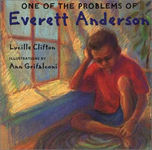
One of the Problems of Everett Anderson

Written by Lucille Clifton

Illustrated by Ann Grifalconi

Publishers: Henry Holt and Company

Ages: 4 – 8

Themes:

Child abuse, helping others, friendship, boys

Opening:

“Everett Anderson sits at home wondering what he should say or do.”

Synopsis:  

Here is the summary from the Parents’ Choice Awards website:

        This is author Lucille Clifton’s eighth book featuring a thoughtful, small black hero facing the everyday problems of growing up in a complex world. Here, sotto voce, she confronts the problem of child abuse as Everett Anderson makes a new friend at school and worries because, daily, Greg arrives with a new scar or bruise mark on his leg. Everett could tell his teacher, but “I’m afraid in case he asks me what I mean and I don’t know exactly.” He also doesn’t want “to make it bad for Greg or for his mom and dad.” Everett’s mother counsels her son to listen to Greg “and hug and hold his friend.” And the listener to this affecting tale has the feeling that Everett’s mother may try to help Greg in other ways. This is a book that could prove invaluable in initiating classroom discussions of a widespread problem that deserves wider recognition and attention.


Why do I like this book:

The illustrations are soft and compelling.  The text breaks your heart and makes you want to go out and save every unfortunate child who has to deal with abuse.  This is a widespread problem in our society…here is a book that can open the door to discussion and honest revelations.  We can empower young children, not only to speak up for themselves, but also to reach out and help others.

Related Activities:

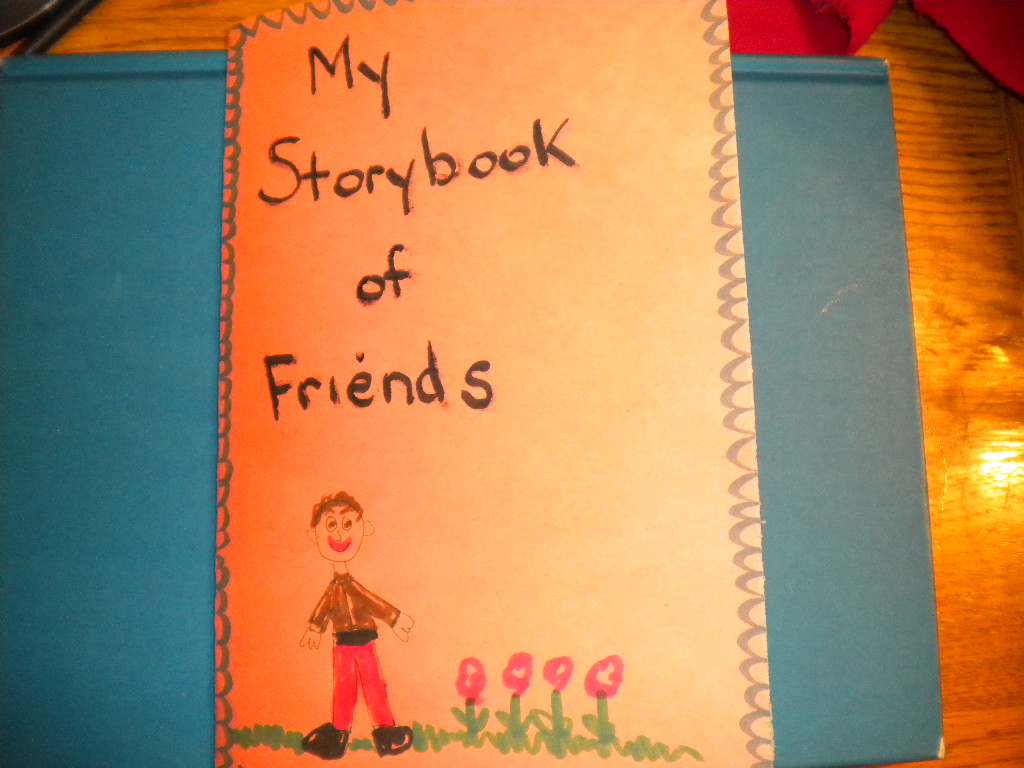
Children love making their own books.  An activity like this one builds reading readiness skills in very young children and develops stronger literacy skills in older ones. 

You will need: One piece of construction paper, two or more pieces of white copy paper, markers or crayons, stapler or hole puncher and ribbon.

1.      Fold the construction paper in half…this is the cover for the book.  Help your child write the title of his book on the cover.

2.      Fold the pieces of white copy paper in half…insert into the cover and staple along the folded edge or use the hole puncher to make two or three holes through all the papers and string a piece of ribbon through and tie to hold the pages together.

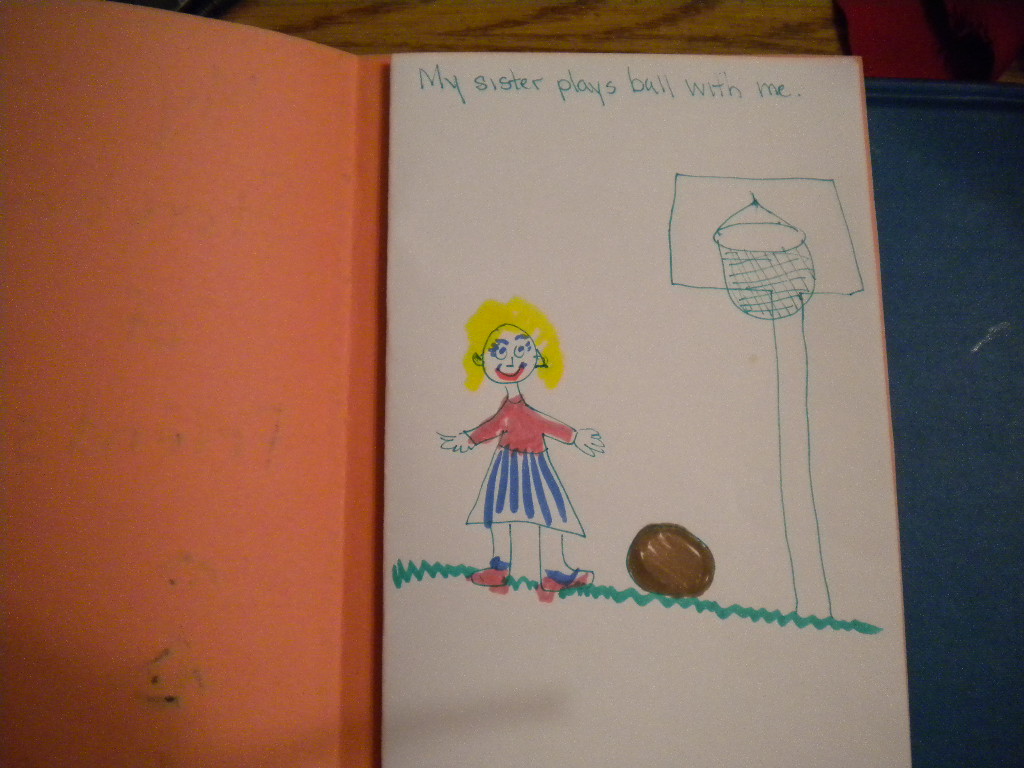
3.      Your child is now ready to make his own storybook of friends.  Encourage your child to draw pictures of his friends on each page.

4.      Ask your child to tell you his story.

Children really get a thrill out of making their own books.   You can use this bookmaking activity in many other ways…have your child cut out pictures from magazines of foods he or she likes, animals, etc.  Your child will have a collection of handmade books that he or she can read to you.

Other activities:

Puppets definitely lend themselves to role-playing and could be used for a follow-up discussion of the book.

Young children love flannel board stories…teachers or counselors can encourage children to discuss this issue using flannel board figures.


This post is part of a series for parents and teachers called Perfect Picture Book Fridays hosted by Susanna Leonard Hill.  Click on her link and find lots of other picture book suggestions with summaries and activities.

PPBF: Crow Boy and World Read Aloud Day

Today is Perfect Picture Book Friday where I link up with Susannah Leonard Hill’s fantastic group of writers who contribute a picture book review and related resources.  Parents and teachers can find the best of the best in picture books…a little synopsis, a thoughtful review, and an activity and/or resources to extend the learning experience.  This is a great way for parents and teachers to preview a book before they take it out of the library or spend money buying it.

My selection today is another classic picture book recommended in Show Me How!…this one from 1955…the author/illustrator, Taro Yashima, won the Caldecott Honor Book Award.  

World Read Aloud Day is coming up on March 7th and I thought that Crow Boy would be a perfect choice to get us all in a global awareness mood.


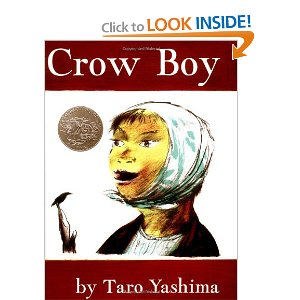
Crow Boy

Written and illustrated by Taro Yashima

Publishers: Viking Juvenile (original edition 1955), Picture Puffins (1976)

Ages: 4 – 8

Themes: Celebrating the uniqueness of each individual, bullying/teasing, mastering tasks and skills, positive attitude, goal-setting, fitting in.

Opening: “On the first day of our village school in Japan, there was a boy missing.  He was found hidden away in the dark space underneath the schoolhouse.”

Synopsis:  Many years ago, in a small village school in the countryside of Japan, a young boy attends school.  Chibi is always perceived as stupid and is treated as an outcast by the other students.  When Mr. Isobe, the new teacher, observes Chibi’s strengths and talents (the boy is a wonderful artist and is also the only person with perfect school attendance even though he has to walk seven miles to school each day), he encourages the boy to participate in the school pageant with an imitation of the voices of crows.  Does Chibi’s performance have any effect on how the children perceive him?  Remember the talent show in Oliver Button is a Sissy.

Why do I like this book

Wonderful illustrations give the reader the sense of the small rural area in Japan…I love books that give young children a window on the world.  The story addresses many important issues as well…bullying/teasing, teacher recognition and encouragement of a student’s gifts and talents, overcoming obstacles in order to achieve one’s goals…as relevant today as it was almost sixty years ago when it was first published.

Related Activities:


Black and White Painting

Although Crow Boy had a difficult time expressing himself verbally, he was able to do so more easily with his artwork.  Painting is a wonderful way to allow a young child to express his feelings and to encourage his creativity.

You will need: Paper (construction paper or grocery bag cut open), black and white non-toxic tempera paint, brushes (or Q-tips) and coverups to protect work surfaces and clothing.

1.      Cover the work surface and your clothing to protect from splatters.

2.      Pour a small amount of black and white paint into two separate containers.

3.      Let your child paint several pictures using different size brushes and/or Q-tips.

4.      When dry, hang up this amazing art. 

5.      Tip to parents and teachers: Art is one thing…crafting is another.  Art is pure expression.  Crafting is following certain rules or steps to produce a particular product.  This activity is art…the child is creating whatever he or she desires…if you ask, “What is this?” or you inquire, “Didn’t you forget the dog’s tail?”…you are passing judgement on your child’s creative voice…I beg you, please don’t!  You can engage with your child by asking, “Please tell me about your art.”  In praising, it is more empowering to say, “I’m so proud of how hard you worked making thick strokes and thin strokes.  Was it difficult?” instead of just saying, “That’s nice!”


Crayola official website with lots of arts and crafts activities and print-outs for kids.

Website for the Japanese American National Museum where you can purchase the documentary narrated by Mr. Yashimo, Golden Village.

Taro Yashimo papers in the de Grummond Collection

This post is part of a series for parents and teachers called Perfect Picture Book Fridays hosted by Susannah Leonard Hill.  Click on her link and find lots of other picture book suggestions with summaries and activities.

SAVE THE DATE:

WORLD READ ALOUD DAY…MARCH 7TH

Do you have anything special planned?

You can go to LitWorld’s website to get more information and/or register…there will be events online and in different locales around the world.

They are a global literacy organization that aims to help entire communities through books.  We all that that, I know!  According to their website: 

“LitWorld’s mission is to use the power of story to cultivate literacy skills in the world’s most vulnerable children through Education, Advocacy and Innovation. Lit World creates resilience building reading and writing experiences which connect and fortify communities.”