Hurray! And Congratulations to all of the beautiful important books chosen for the Sydney Taylor Honor Awards. For the full listing, you can find the schedule on the AJL post: https://jewishlibraries.org/2024-blog-tour-sydney-taylor-book-awards/
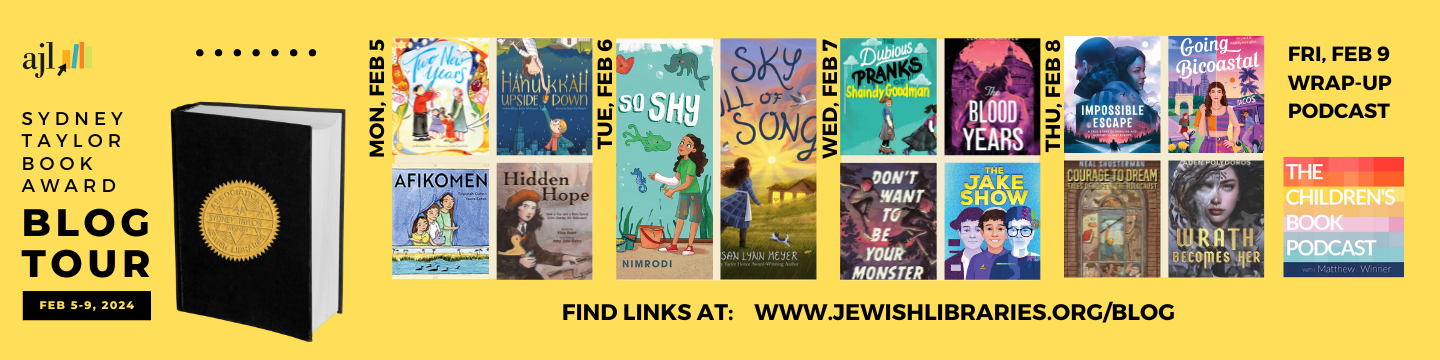
I’m honored that Picture Books Help Kids Soar was again asked to be part of the tour…and I’m thrilled to share this wonderful picture book, HIDDEN HOPE, written by Elisa Boxer and illustrated by Amy June Bates.
What a super awesome post this is going to be – we’ve got a Q&A with both author Elisa Boxer and illustrator Amy June Bates, plus each of them has shared the story behind the story and also some peeks inside the book. Hold onto your hats, dear friends! We are going to hear from author Elisa first.
ME; WELCOME, ELISA! We are so happy to be part of the Sydney Taylor Book Honor Awards Blog Tour.
ELISA: Vivian, thank you so much for the chance to share more about Hidden Hope. Although it’s the story of a teenage French Resistance fighter who used a toy duck to hide secret documents from the Nazis, it’s also the story of how important it is to never hide the truth of who you are. I’m so happy and honored to be able to share that message with more readers, parents and educators.
ME: What inspired you to write this story?
ELISA: In 2018, I was researching a different book about the French Resistance, when I came across this photo online:
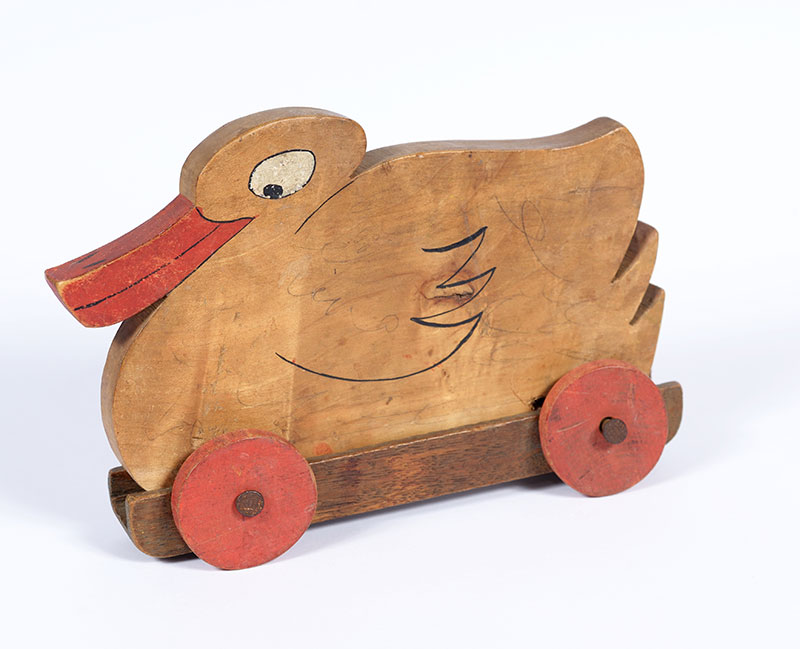
It’s the wooden duck on display at Yad Vashem, the World Holocaust Remembrance Center. When I learned that the duck’s hollowed-out compartment was used to hide secret documents from the Nazis, I had to know more. I wasn’t sure at the time where my research would take me, I just knew that I had a strong desire to see if I could possibly turn this into a picture book. As a Jewish journalist with family members killed in the Holocaust, I’ve long been drawn to uncovering and sharing stories of World War Two resistance, defiance, and heroism.
People have been asking me whether it’s hard to write about such a dark topic. And while there’s no question that this was an unimaginably devastating time in history, Hitler’s goal was to create a master race and erase the Jewish people from the face of the earth. The Final Solution. And yet, so many of us are here writing about it. We’re bringing these stories to light. We’re the descendants that were never supposed to be here. And not only are we here, we’re raising our voices to tell the stories that the Nazis never wanted told. There is something incredibly uplifting and empowering about that.
ME: Oh my…thank you so much for these words. and all your research and for the book.
And now to learn more about your journey.
Who were your favorite authors/illustrators when you were a child?
ELISA: I was always drawn to authors and illustrators whose work invited me to feel my emotions on a deeper level than I felt permission to in real life. Creators like William Steig. I still cry when I read Sylvester and the Magic Pebble, because that sense of having felt often invisible to the people closest to me; wanting to be seen for who I was – that was such a strong feeling in my childhood that I didn’t have words to express, but there it was on the page.
ME: What do you know now that you wish you knew when you first started writing?
ELISA: I wish I’d known early on to trust my creative voice and vision; that the stories people raise an eyebrow at are the stories I need to tell, rather than the stories I should abandon.
ME: Where do you like to write – inside, outside, special room, laptop, pen and paper?
ELISA: All of the above! I’d say my favorite place to write is on the floor with a notebook and pen. The floor writing thing goes back to the 1970s. When I was in elementary school, some of my favorite books featured Frances the hedgehog, by Russell Hoban. In A Baby Sister for Frances, she packs a bag and runs away – under the dining room table. Two of my favorite things to do at the time were making forts and writing books. So, I combined the two and wrote my earliest manuscripts under our dining room table. Here’s one:
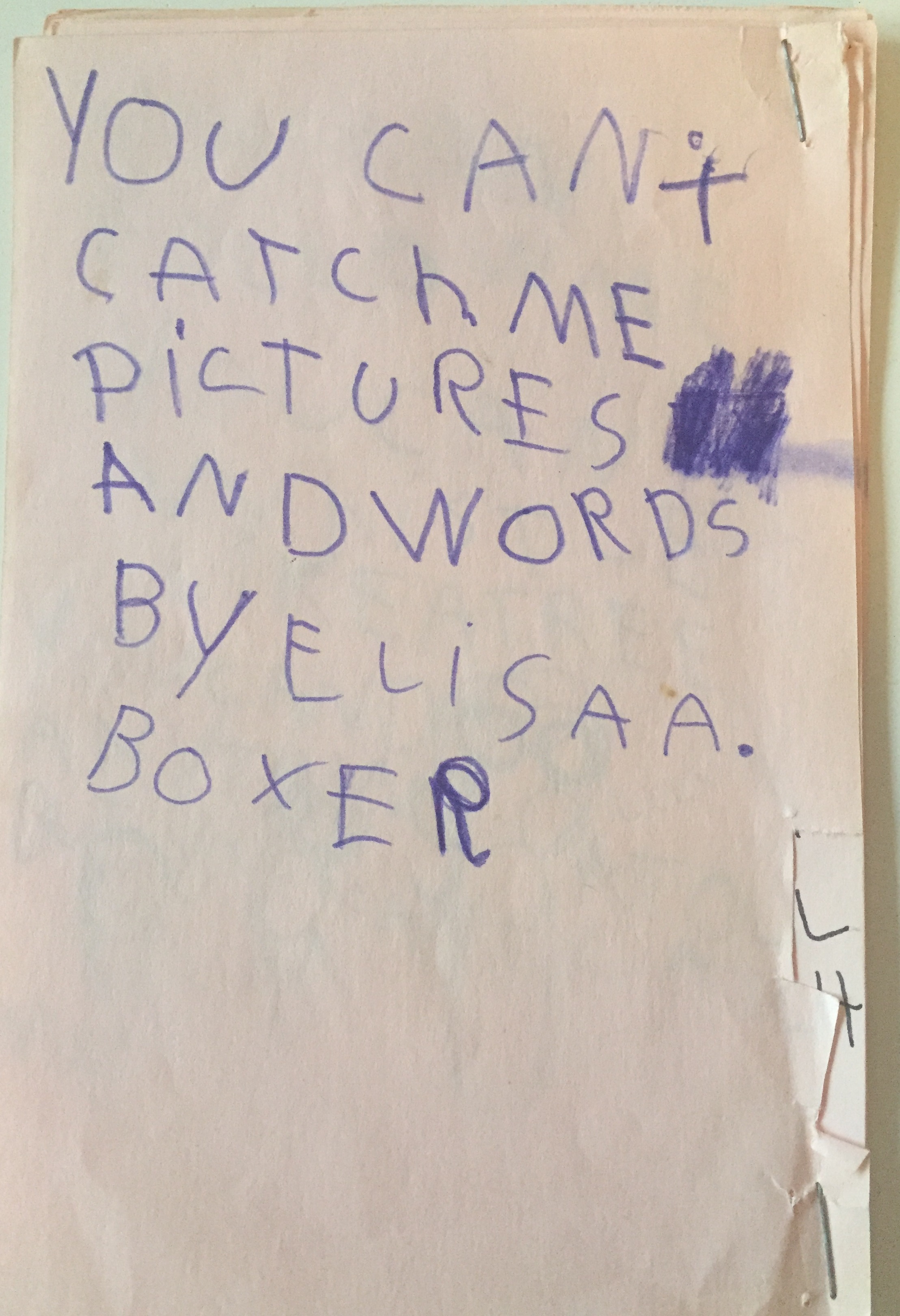
As you can see, I’ve been writing about resistance and defiance for quite some time.
ME: When do you write – early morning, late in the day, middle of the night, on schedule, as the muse strikes?
ELISA: It totally varies, and it’s never when I planned. Just when I think I have a big chunk of time to get into that deep creative space, something else will come up that needs my attention. And on those packed days when I don’t think I’ll be able to squeeze in any writing time, inspiration will strike and I’ll do some of my best writing on that grocery list that had been crumpled up and stuffed into the side door pocket of my car.
ME: Why do you write for children?
ELISA: The books I write tend to feature people who do the unexpected; who harness their courage in barrier-breaking ways; who go against social norms in service to standing up for something they believe in. When I really dig in to why I write for children, this is it. I want to inspire them to harness the hero within. I want them to know they are innately worthy of following what feels right and true to them, even if it’s an unpopular course of action. I want to give them encouragement to honor that inner voice, especially when it’s saying something different than all the voices around them.
ME: Also, if you have any thoughts or advice for aspiring writers, please share. As well as anything else you want to talk about that parents, educators, writers, librarians might want to hear.
ELISA: My best piece of advice is to get curious about the underlying reasons why you might be drawn to telling a particular story. I wanted to tell the story of Judith Geller and the toy duck, for example, because it’s full of intrigue and I wanted young readers to find inspiration in this little-known hero who triumphed in such a dark time. And I wanted this book to take its place alongside others that are opening up wider conversations about Antisemitism. But as I began really feeling into the deeper layers, I started to realize that this is, ultimately, a story about the importance of never ever having to hide the truth of who you are. Although nothing can and should be directly compared to the horrors of the Holocaust, I believe many of us have aspects of ourselves that perhaps we feel unsafe showing to the world. I found myself asking some uncomfortable questions, like: “In which situations and with whom in my life do I feel like I have to hide the full truth of who I am?” These aren’t generally conscious questions. But I hope one of the takeaways for young readers, as well as parents, educators, writers, and librarians, is deciding to show up in any given situation as the most authentic version of who you are. Never hiding. Always bringing your fullest self into the world, without apology.
ME: WOW! Thank you so much, Elisa…your answers are informative and insightful…and we are grateful for all that you shared.
And now, I’ll suggest that everyone go get a fresh cup of tea or coffee or hot chocolate…because we’ve got an equally awesome Q&A with illustrator Amy June Bates.
INTERMISSION – MUSIC PLAYING – FOLKS, PLEASE GRAB A SNACK AND A DRINK AND COME RIGHT BACK!!!!
ME: HELLO, AMY! Thank you for stopping and for spending time with us on Picture Books Help Kids Soar. We asked you a different first question…a question many of us writers wonder about.
What were your thoughts when you received the manuscript?
AMY: I thought right away it was a great story and I was excited about the possibility of doing it. I was also daunted by the seriousness of the story, and if I was the right choice and would be able to do it justice.
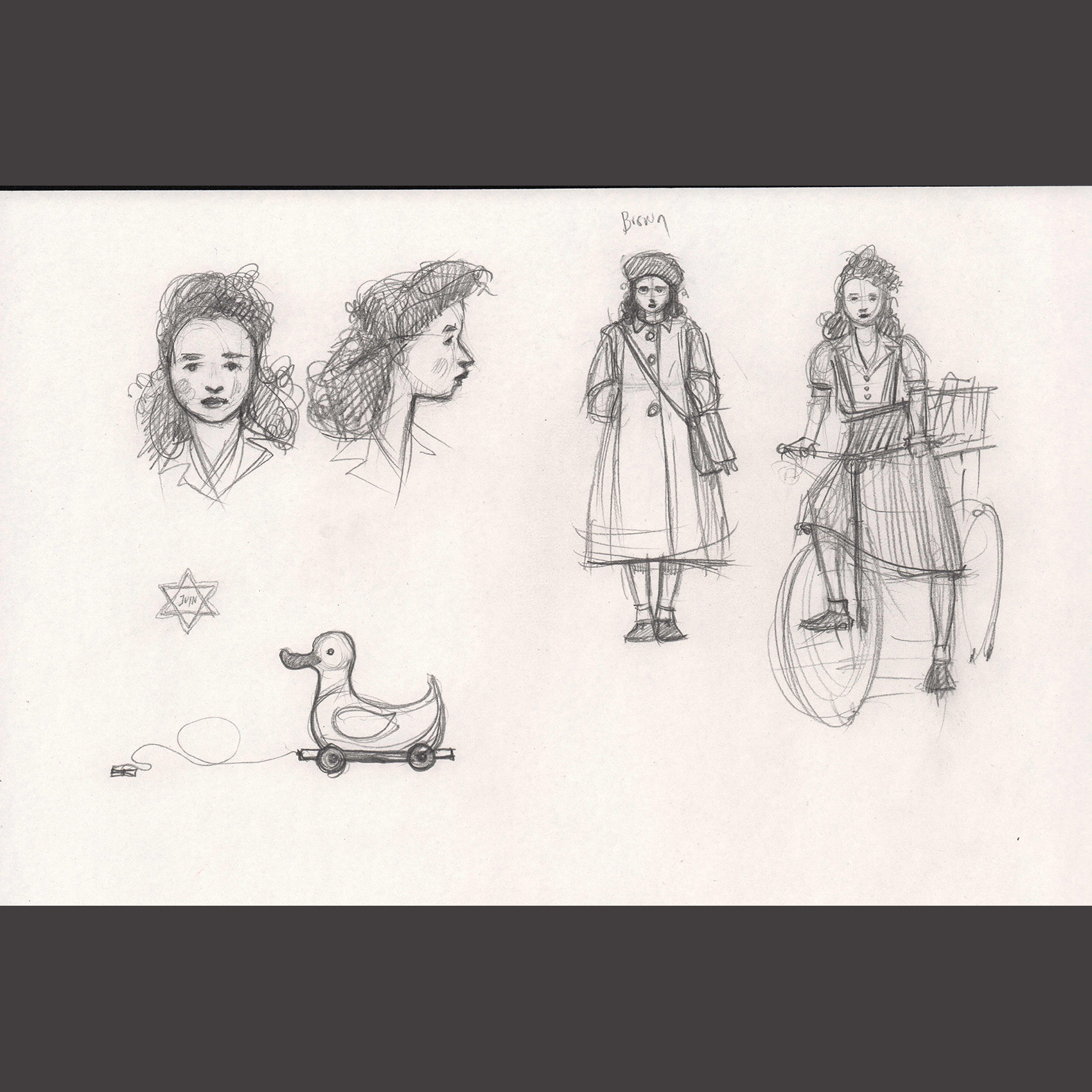
I had a really hard time finding any information about Judith Geller. I almost started to wonder if she was a real person. It is strange to research someone with multiple alias’- all from the occupation. It was like she had sort of disappeared. But because of the difficulty of her life in France she moved to Israel after the war and once I realized this I was able more information and a small documentary about her and an autobiography that she had written in French.
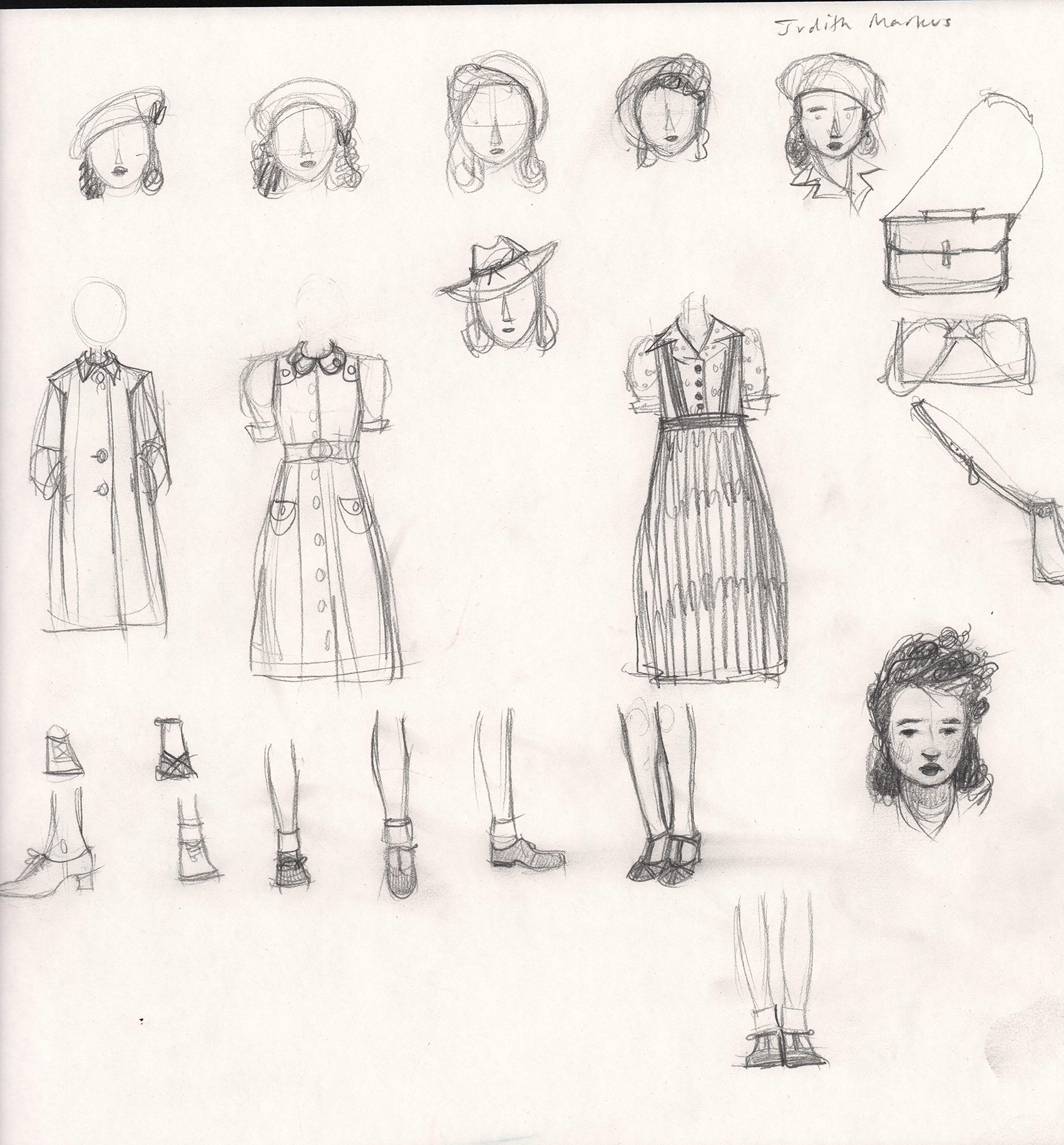
My job once I get a manuscript is to build a visual narrative to accompany the text. But to do that I needed more information.
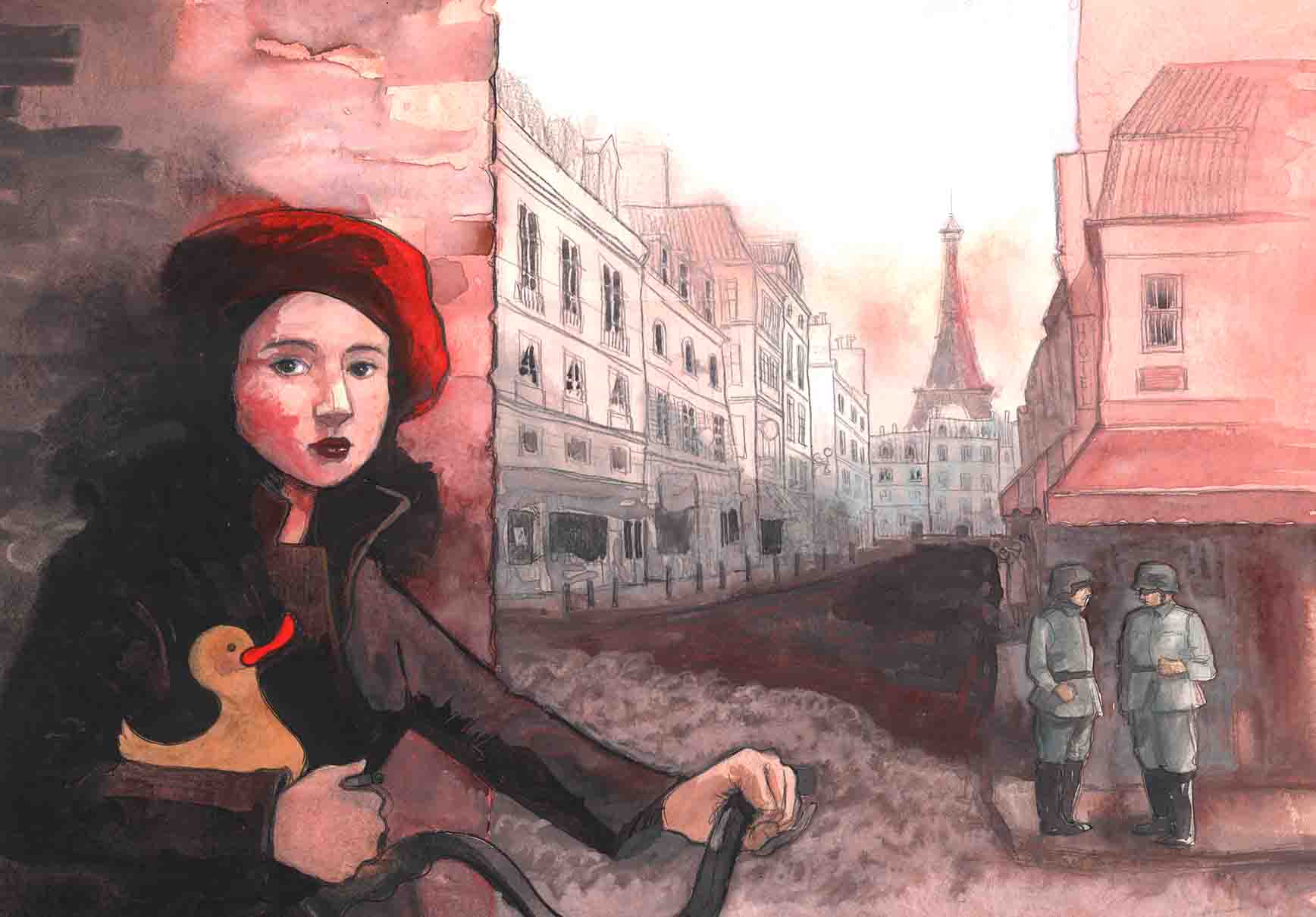
For example, you can say with words “She rode down the street” But visually what street, where? Since this is Paris I like being specific. Figuring out roughly where she would have been and being as accurate as possible pleases me.
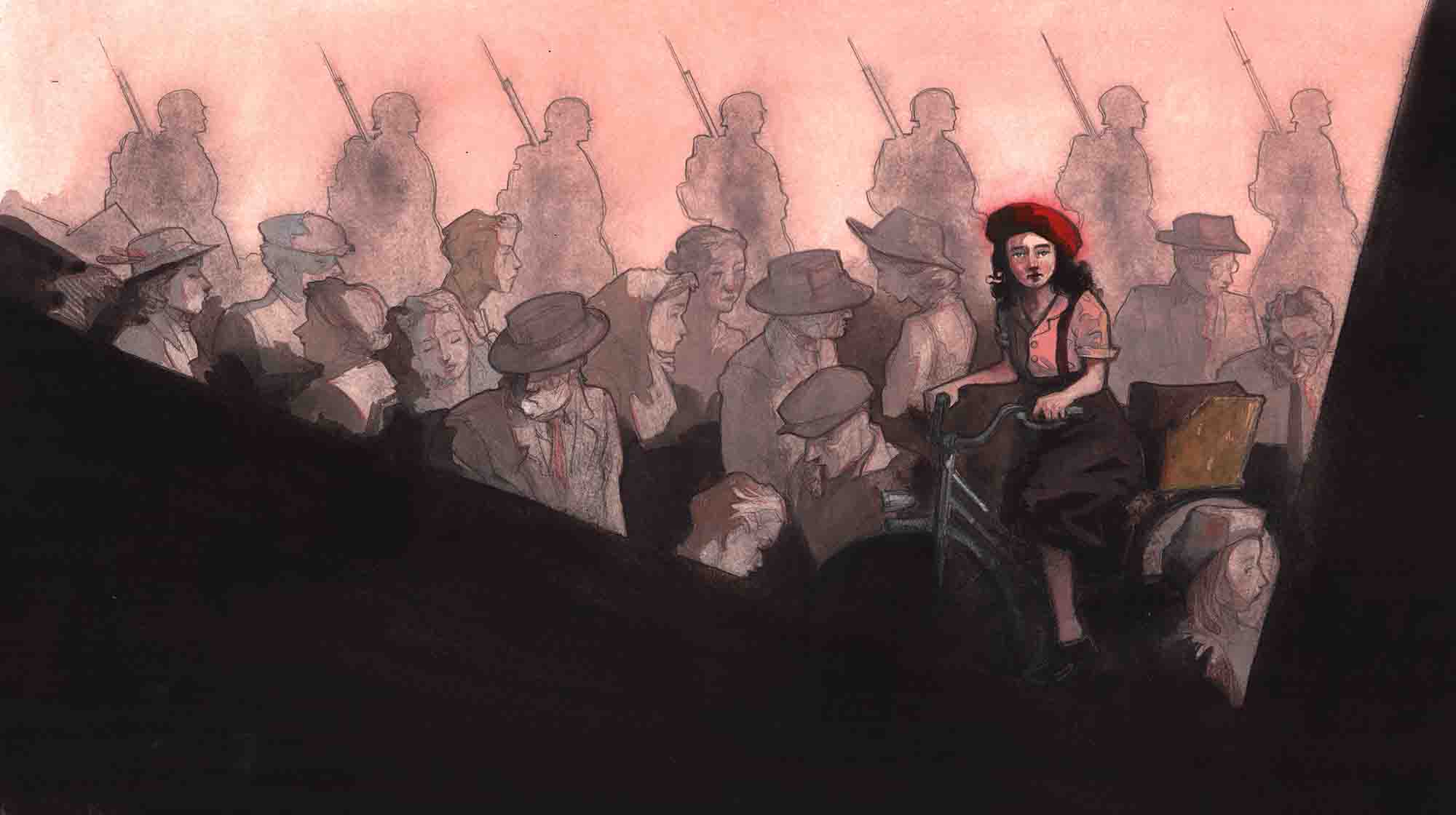
It feels like the least I can do for an amazing brave woman, to tell her story the best way I can.
ME: THANK YOU! THANK YOU! We are so grateful for this behind the scenes snapshot of what a challenging task illustrators have…we are grateful to you! And we are looking forward to hearing more about you and your own journey.
Who were your favorite authors/illustrators when you were a child?
AMY: Maurice Sendak, Mercer Mayer, Ernest Shepherd, Arthur Rackham, Trina Schart Hyman, James Marshall, Norman Rockwell.
My favorite book was probably FERDINAND by Munro Leaf
My Dad took me to a lot of art museums. I’ve always loved art.
ME: What do you know now that you wish you knew when you first started writing?
AMY: Everyday average people are usually hiding much more interesting stories than the most famous people that always get written about.
ME: Where do you like to write – inside, outside, special room, laptop, pen and paper?
AMY: I paint in my attic studio that looks out at my oak tree, a view that likely hasn’t changed much in the last 150 years.
I draw in a sketch book, I paint with watercolor and gouache. I try to take one day a week to play and experiment with different artistic things.
ME: When do you write – early morning, late in the day, middle of the night, on schedule, as the muse strikes?
AMY: As an illustrator I don’t have the luxury to work as the muse strikes J That sounds kind of nice though. I know what you mean. I work on a book the same way anyone would work on a job, 9-5. Sometimes I have to pull late hours etc.
For my own work, I guess my philosophy on creativity is that the more you show up to your desk, the more your creativity will show up too. Hope that makes sense. If I only rely on “inspiration” to strike then I never know if it will. But if I am doing the work, at least it’s going to be more likely to show up, like a muscle. Sometimes my ideas that I am working on are better than others. The thought I always have is “Well, its what’s for dinner.” Because for me its important to produce work and then later I can decide if its good or not.
I love to draw in nature when I can, and when its WARMER!
ME: Why do you write for children?
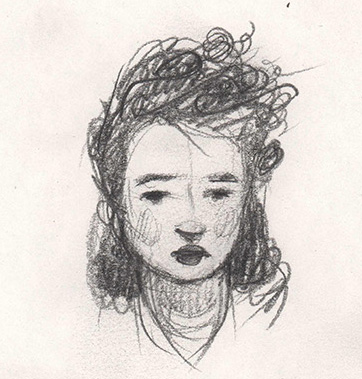
AMY: What a good question. I think it’s because I haven’t grown up myself and so it feels relevant. I love stories. I love artwork. I love the two together. I love the specific art form of the picture book. It employs a specific set of narrative sequential art, pattern, timing, and Oh! the battle, compromise, coming together of words and image. I love it. I want that relationship to go on and on when its good.
WOW again…such amazing info and insights. Thank you so much, Amy.
Dear readers, I’m sure you’ll want to check out all of Elisa and Amy’s books.
Here is a little more info about Elisa:
Elisa Boxer is an Emmy and Murrow award winning journalist whose work has been featured in publications including The New York Times and Fast Company. She has taught journalism at the college level and has reported for newspapers, magazines and TV stations. Elisa has a passion for telling stories about unsung heroes who have broken through social barriers and found the courage to create change. She is the author of numerous children’s books including The Voice That Won the Vote, One Turtle’s Last Straw, The Tree of Life, Covered in Color (called “compelling from cover to cover” in a Kirkus starred review) and Hidden Hope, a Junior Library Guild selection that earned three starred reviews and the Sydney Taylor silver medal. Elisa lives in Maine and has many more children’s books on the way, including Beam of Light: The Story of the First White House Menorah, published by Penguin Random House/Rocky Pond Books and available now for preorder.
And some info about Amy:
Amy June Bates is an Illustrator + Artist + Writer + Printmaker + probably some other things as well, born in Utah and based in Pennsylvania.
She says:
I’ve been an Illustrator for 20 years. I’ve written a few books and I’ve loved a few books to death. I love painting and drawing, but I am also OBSESSED with carving and printmaking. I lived in Japan for 3 years and I got so fascinated by wood block printing. I somehow never thought I could or should do it. I have these old Taisho era Sharaku prints on my walls that I’ve been staring at for years. Well one day I just knew it was time. So I started “Never You Mind Press”
To keep up to date with sketches, projects, books and doggy drama you could follow me on Instagram, it’s where I am most up to date. Honestly, I can’t be everywhere at once.
Hahaha…I totally echo Amy…none of us can be everywhere at once, even though we may try. Please do follow these amazing creators on their preferred social media platforms, and please buy and review their books! We are so grateful for all that they’ve shared with us!
I hope you all have a wonderful week.
 VIVIAN KIRKFIELD - Writer for Children
I’ve read HIDDEN HOPE. A great book!
LikeLike
I’m so glad your research took you to this book.
LikeLike
I love HIDDEN HOPE and am so glad to learn more about its journey to publication. Congratulations, Eliza and Amy!
LikeLike
What a fantastic interview, ladies! I really enjoyed it.
LikeLike
Hidden Hope is a wonderful book! I enjoyed hearing the story behind the book. Congrats to Eliza and Amy! Great interview! Thank you, Vivian🥰
LikeLike
Love this book! Congratulations, Eliza and Amy!
LikeLike
Great insight…I want to give them encouragement to honor that inner voice, especially when it’s saying something different than all the voices around them.
LikeLike
Congratulations, Eliza and Amy!
Great post! 🙂
LikeLike
Vivian, thanks so much for featuring this important book. Elisa, thank you for seeing that toy duck with writers’ eyes and for finding a way to bring this story to life, and thank you, Amy, for your dedication to historical accuracy in visually telling this story. You are all inspiring!
LikeLike
I love hearing the inspiration behind books and the behind the scenes work of writer and illustrator. It sounds fascinating and the illustrations are drawing me in.
LikeLike
So wonderful! I look forward to reading this one. Thank you for sharing. Congratulations, Elisa and Amy!
LikeLike